Aid as Handmaiden for the Development of Institutions Book Review
Social Innovations
But Say "No"
Dead Assist: Why Aid Is Non Working and How There Is a Better Style for Africa by Dambisa Moyo
- Cite
- share
- comment
- downloadhttps://ssir.org/images/manufactures/2009SU_Reviews_Wales2.pdf
- club reprints
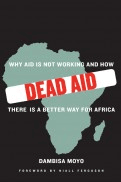
Dead Aid: Why Assistance Is Not Working and How There Is a Ameliorate Way for Africa
Dambisa Moyo
188 pages, Farrar, Straus, and Giroux, 2009
Buy the volume »
As the global financial crisis unfolds, those least responsible—our world'due south poor—will exist most afflicted. Many have chosen upon President Obama to uphold his campaign delivery to double foreign help. But Dambisa Moyo'south book, Dead Aid, challenges us to recall again. Although nosotros can all agree that ending poverty is an urgent necessity, there appears to be increasing disagreement about the best way to accomplish that goal.
Born and raised in Lusaka, Zambia, Moyo has spent the past eight years at Goldman Sachs as caput of economical enquiry and strategy for sub-Saharan Africa, and before that as a consultant at the World Bank. With a PhD in economics from Oxford University and a chief's degree from Harvard University's John F. Kennedy Schoolhouse of Authorities, she is more qualified to tackle this discipline.
In Dead Aid, Moyo comes out with guns blazing confronting the aid industry—calling information technology not just ineffective, but "cancerous." Despite more than $1 trillion in development aid given to Africa in the past l years, she argues that aid has failed to deliver sustainable economic growth and poverty reduction—and has actually fabricated the continent worse off . To remedy this, Moyo presents a road map for Africa to wean itself of help over the side by side v years and offers a menu of alternative means of financing development.
Moyo opens her instance past writing, "Betwixt 1970 and 1998, when aid flows to Africa were at their peak, poverty in Africa rose from 11 percent to a staggering 66 percent." Today, Africa is the only continent where life expectancy is less than historic period threescore. Sub-Saharan Africa remains the poorest region in the world, where literacy, health, and other social indicators have plummeted since the 1970s.
Pulling the states through a quick history of aid, Moyo covers the many means its intent and structure have been influenced by world events. She systematically challenges assumptions about the efficacy of the Marshall Plan, International Evolution Association graduates, and "conditionalities" that crave adherence to prescribed economic policies. "By thwarting accountability mechanisms, encouraging rent-seeking beliefs, siphoning abroad talent, and removing pressures reform inefficient policies and institutions," help guarantees that social capital remains weak and countries poor. And Moyo's list of help's sins goes on—including the crowding out of domestic exports and raising the stakes for conflict.
So what does Moyo advise nosotros do? In her ain version of shock therapy, she asks, "What if, 1 past one, African countries each received a telephone phone call, telling them that in exactly five years the aid taps would be shut off —permanently?" The shock would strength them to create a new economical program that phases in alternative financing mechanisms as aid is phased out, she argues. These new financing mechanisms should include increased merchandise (particularly amid African nations and with emerging markets similar China, Republic of india, and Brazil), strange direct investment, entrance into international capital markets, and increased domestic savings through remittances and microfinance. The stop goal is to phase reliance on assistance downwardly to 5 percent or less within five years.
Audio impossible? Moyo doesn't think and then. Implementing this plan volition be "dead easy," she claims, only volition require political volition. This political will, Moyo argues, must be rallied by Western activists, for they are the but ones with the ability and the incentive to drive change. "It is, after all, their money being poured down the bleed." She is not the starting time to call for a movement away from aid dependency—although she may exist the fiercest.
Moyo has only proven correlation, not causation, and although we can't exist sure how her prescriptions would hold upwardly in the face up of a global recession, she challenges the states to think before we human action. Moyo expands the boundaries of the development chat—one that has go both more vibrant and more nuanced in recent months. Those of us rethinking aid tin all hold that the time has come for deeper and more straight involvement of Africans in setting their own evolution course. As the African proverb goes: "The best time to establish a tree is twenty years ago. The second-best time is now." Permit united states of america not waste matter whatsoever more time. Africa's moment, and our moment, is now.
Source: https://ssir.org/books/reviews/entry/dead_aid_dambisa_moyo
0 Response to "Aid as Handmaiden for the Development of Institutions Book Review"
Post a Comment